In this three-part series, we examine the evolution of patient identity. Part 1 explores the strategic necessity of deterministic matching. Part 2 provides a technical guide on attribute bundles. Part 3 will look at the future of privacy and security through Digital Identifiers.
The Patient Matching Challenge
Healthcare organizations still struggle to match patients to their medical records across systems. The consequence: providers often see partial pictures of patient health records and lack the information they need to provide the best care. For patients, that can mean filling out the same forms again and again, retelling their health stories, and struggling to remember, and recover their logins across provider portals. These gaps don’t just slow care — they affect safety, trust, and outcomes.
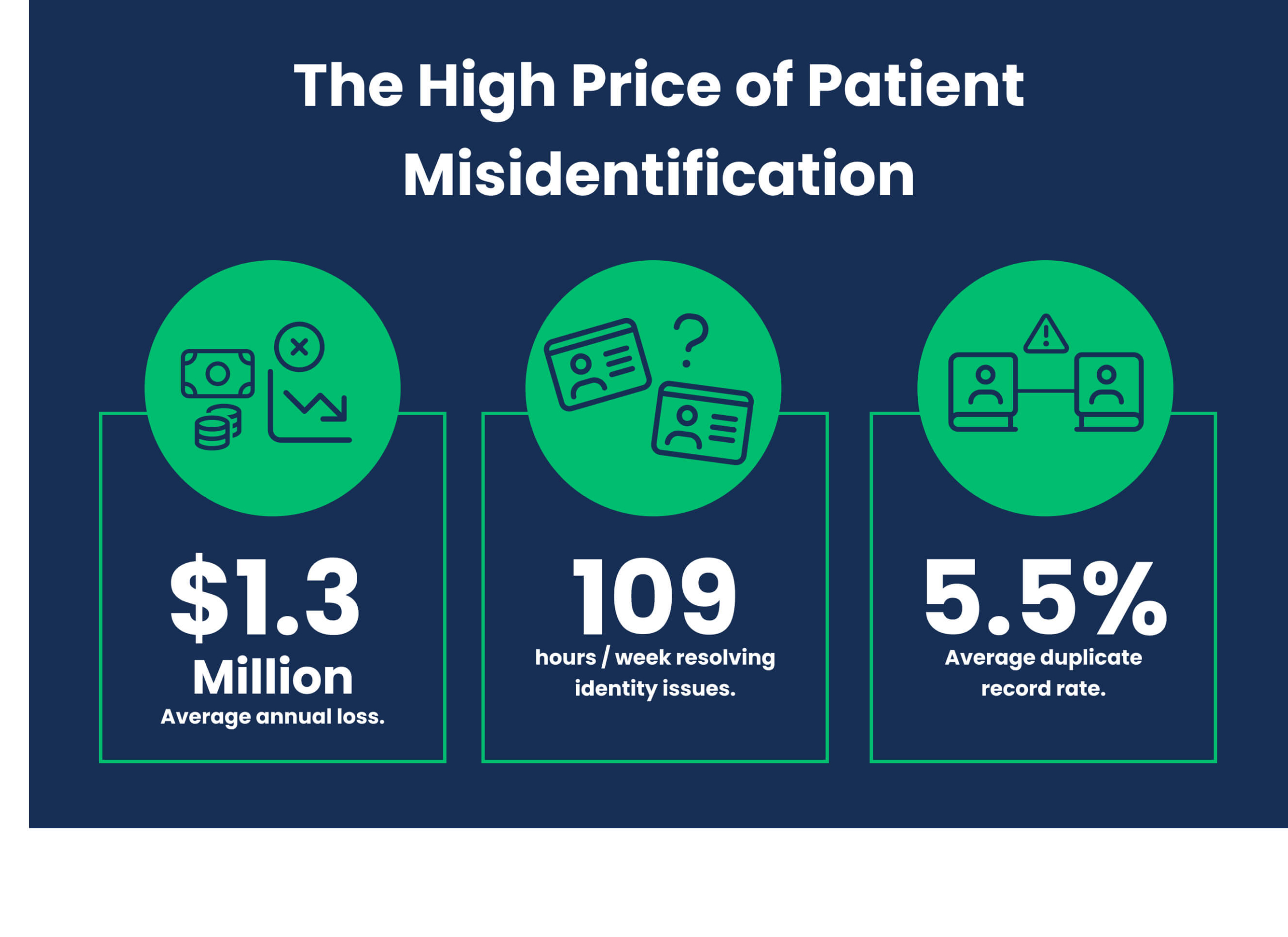
A 2022 survey of healthcare executives, clinicians, IT leaders, and other professionals found that on average, organizations spend 109.6 hours per week and over $1 million per year to resolve patient identity issues, with larger organizations dedicating even more resources. Respondents also reported a duplication rate of 5.5% at their organizations, on average. And with Americans making over 320 physician visits per 100 people annually, error rates compound quickly. Patient identification errors and inaccuracies can cause adverse events that endanger patient safety, diminish care quality, and drive up healthcare costs.
The time for action is now. The Centers for Medicare and Medicaid Services’ (CMS) “Kill the Clipboard” initiative and new Interoperability Framework have the potential to end the status quo of siloed systems and mismatched records.
Seizing this opportunity starts with digital identity. For healthcare organizations, ID.me’s approach to digital identity solves some of the biggest challenges in patient matching.
The Solution: Secure, Deterministic Matching with ID.me
ID.me takes a deterministic approach to digital identity that removes the guesswork from matching records.
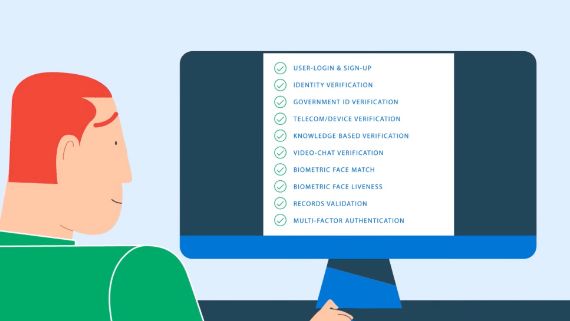
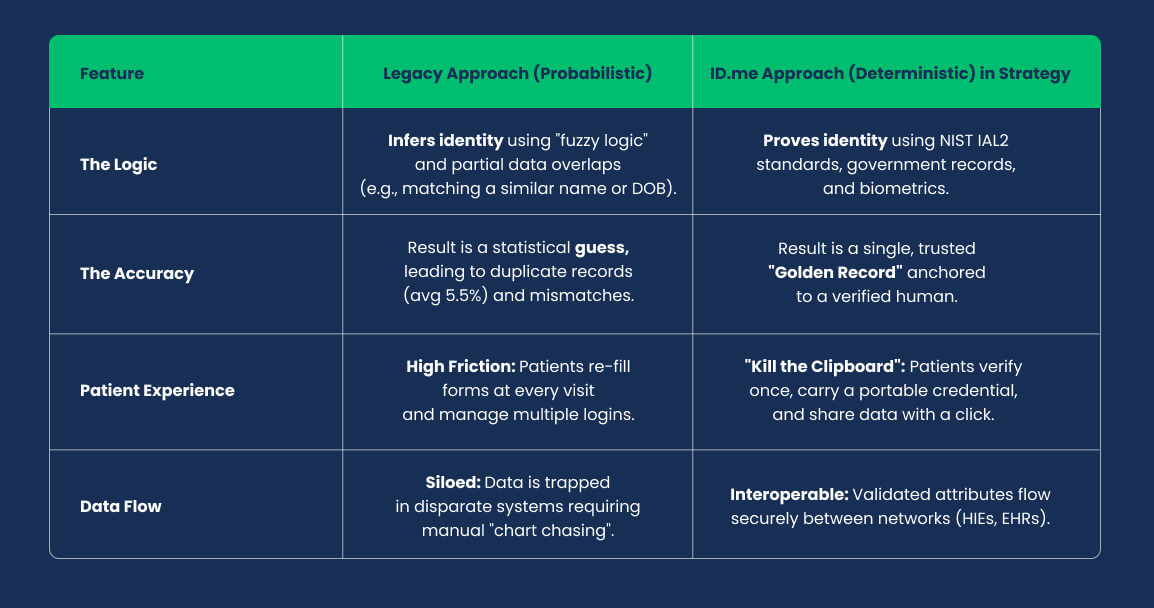
Unlike probabilistic algorithms, which try to infer identity based on fuzzy logic or partial overlaps, ID.me uses high-assurance deterministic identity proofing. This approach meets the National Institute of Standards and Technology’s (NIST) rigorous standards for consumer authentication (IAL2/AAL2) – including biometrics and validation of profile attributes against authoritative sources such as government records. The result is a trusted credential that follows the patient wherever they go – no need to re-enter personal or health information. For patients, that means less friction and more control. For providers, it means instant confidence in a complete health picture and accurate patient-record matching.
The reusability of this credential is key to breaking down siloes. Instead of re-entering their information at every visit with a new provider, an ID.me-verified patient can simply consent to share their information with a few clicks. Then, providers can instantly match the patient to the right data – no “chart chasing” required.
This identity-centered approach yields concrete benefits across the healthcare ecosystem.
For provider organizations, this approach:
- “Kills the clipboard” with a frictionless, digital-first onboarding process that utilizes a universal credential – eliminating the need to create another username and password and automatically populating information on patient intake forms.
- Saves staff countless hours of clerical work and improves bill capture by ingesting clean, authoritative patient data that flows downstream into onboarding, billing, and clinical documentation systems.
- Deduplicates records through deterministic data and establishes a “golden record” that will ensure data consistency across encounters.
For Health Information Exchanges (HIEs), Qualified Health Information Network (QHINs), and Electronic Health Record (EHR) vendors, this approach:
- Enables seamless, secure data exchange by ensuring consistent identity resolution across systems. Verified digital identities allow longitudinal health data (e.g., demographics, medical history, immunization records, provider notes) to flow securely between networks. ID.me keeps this information current through referential matching against a large set of demographic data.
- Supports better continuity of care, giving clinicians a fuller picture of patient health at the point of care and enabling more informed decision-making.
- Strengthens compliance, as every ID.me verification is logged and auditable.
Embedding digital identity into the care journey ultimately empowers every participant to focus on what matters most: delivering high-quality care.
Digital Wallets Solve Patient Matching at Scale
To fully transform patient matching, patient and provider centric solutions where login and trusted identity moves with the individual is the answer.
ID.me has enrolled over 160 million users into our digital wallet. More than 80 million Americans have proved their identity to the federal standards for trust. We have issued reusable digital identity credentials into their wallet that let them easily and safely prove their identity to any organization that accepts ID.me.
When it comes to proving it’s you, there is nothing like a digital wallet where each individual has full control over their unified identity. This is the answer. Not data brokers and invasive solutions.
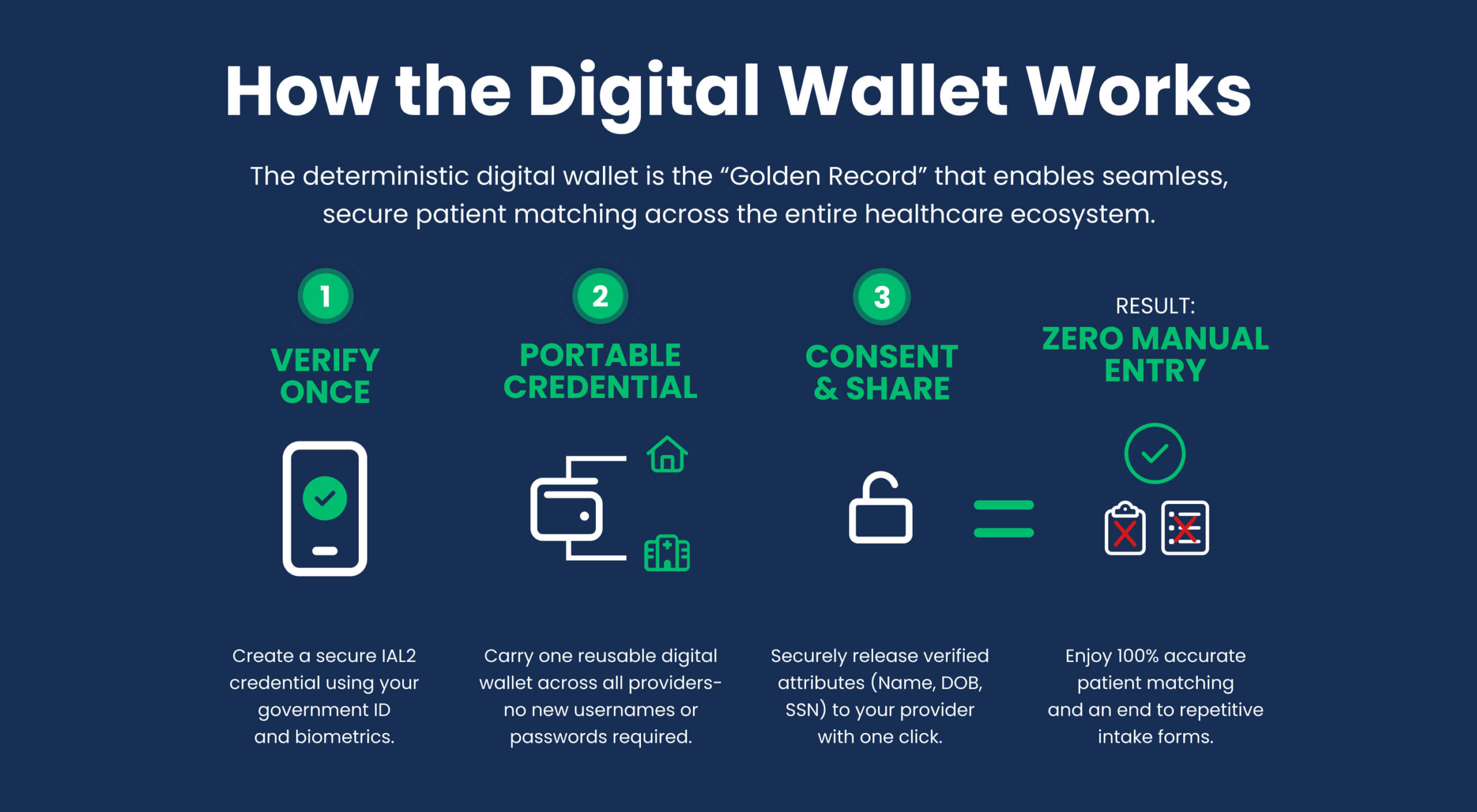
With a digital wallet, patients have a golden record of accurate data they can release by providing consent. Unlike healthcare organizations who may not detect inaccuracies or have a way to solve inaccuracies, patients can easily recognize errors and have the means to address those errors through their relationship with their digital wallet and ID.me.
A Better Healthcare Future
Inaccurate patient matching is more than just a technical challenge or financial drag. It is an obstacle to delivering the care patients need.
Digital identity is key to bringing about a better future. For patients, it provides a trusted credential that reduces friction wherever they seek care. For providers, it breaks down siloes, saving precious time and resources. ID.me is already partnering with leading health organizations and federal agencies such as the U.S. Department of Health and Human Services and the Department of Veterans Affairs to make this vision a reality.
The future of healthcare depends on trust. By embedding secure, deterministic identity into every patient interaction, we can deliver on that promise.
Let’s make that future possible – together.
Understanding the strategic urgency is only the first step. To see how this works in practice, and to learn which data attributes create the strongest deterministic matches, read Part 2: A Practical Guide to Technical Execution.