
In Part 1 of our Patient Matching Series, we discussed the staggering cost of misidentification, including the $1.2M average annual loss per facility and the risks to patient safety. Now that we have established why a shift to deterministic matching is essential, we must address the how. Effective identity resolution requires understanding which attribute combinations provide deterministic matches versus those that merely narrow the search.
Getting patient matching right requires understanding which attribute combinations provide deterministic matches versus those that merely narrow the search. Let’s break down the logical keys that healthcare organizations should prioritize.
Deterministic Matching Strategies
Name + DOB + SSN
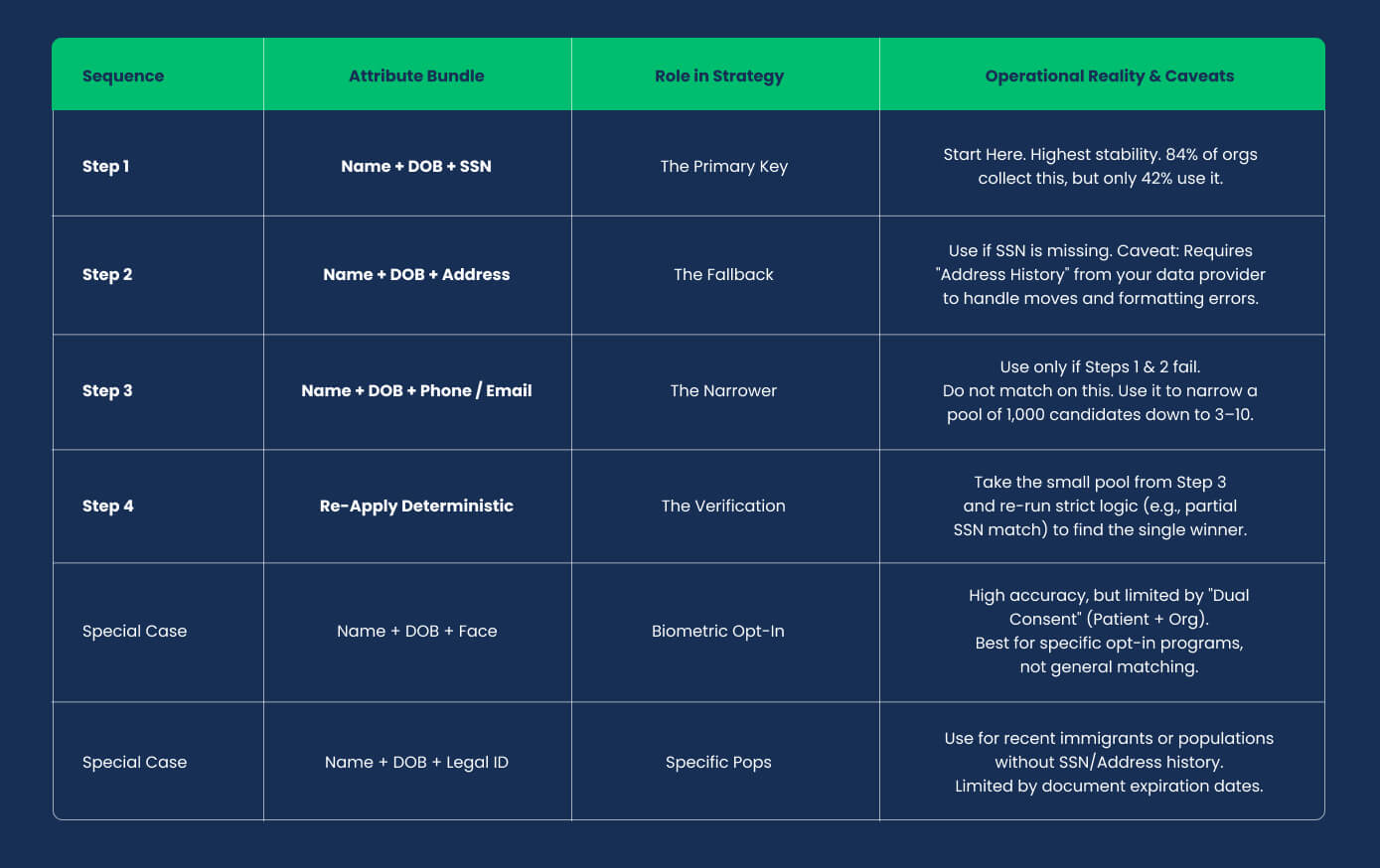
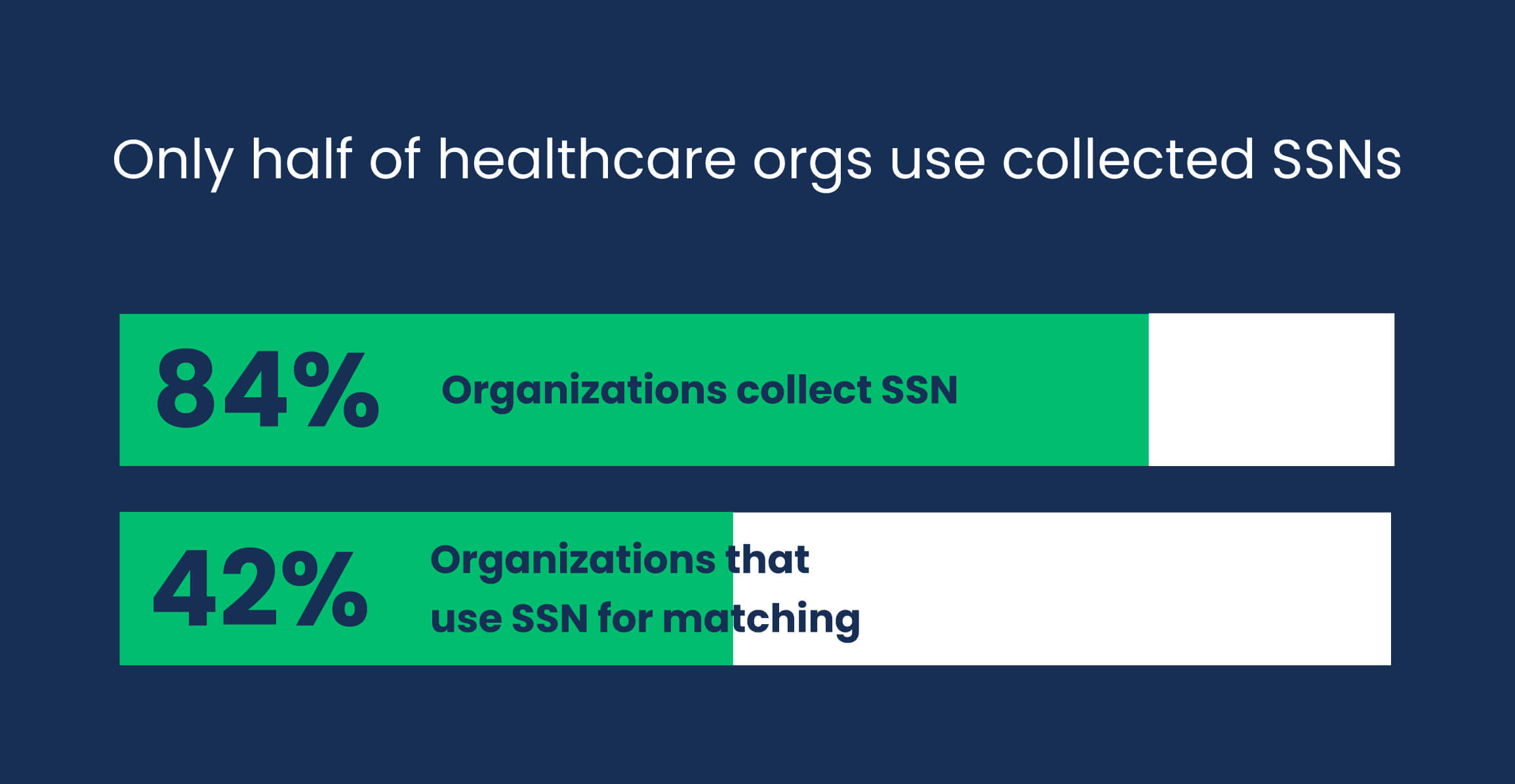
Healthcare organizations should match on DOB and SSN first as those identifiers are highly stable. Names can change over time, and nicknames can complicate matters, so the healthcare organization should match on DOB and SSN and then have appropriate feedback loops to resolve name change history. Ideally, CSPs will provide names, including nicknames and aliases, and name change history so any discrepancies can be resolved without making the patient do more work. 84% of healthcare organizations collect SSNs but only 42% use them for patient matching. By matching on this attribute bundle alone, deterministic patient matching can dramatically improve—empowering patients and providers alike and enabling interoperability.
Name + DOB + Address
For situations where SSN is not available as a unique identifier, Name + DOB + Address can uniquely resolve a patient. For this method to work, Credential Service Providers need to provide Name and Address history so Relying Parties can use different combinations of Name and Address over time. The simplest way of accomplishing this is to lookup the address in the CSP’s payload within the healthcare organization’s system and then search for name and DOB matches against the payload. This method is effective but will require navigating operational complexities involving transcription errors, nicknames, and changing values over time which increase difficulty.
Name + DOB + Face
Biometric matching offers strong deterministic matching when available, but face matching requires consent from both the patient and the organization to support biometric matching. This might not be feasible since the CSP can get consent but the healthcare organization may not have consent to search for a match. This dual consent barrier significantly limits deployment scenarios, making face biometrics most practical for explicit patient opt-in programs rather than universal matching strategies. It can be overcome in situations where the CSP collects biometric consent, matches to the healthcare organization’s records using demographic data, and then leverages Face for subsequent authentication.
Name + DOB + Legal ID Document Numbers
Legal ID document numbers such as passport numbers, driver’s license numbers, and permanent resident card numbers provide unique identifiers tied to the person. However, coverage in terms of match rates won’t be as high as SSN or Address because legal ID documents change over time, particularly after address changes, which makes longitudinal matching more difficult. Additionally, healthcare organizations might not collect legal ID identifiers and use them for patient matching. While these identifiers work well for specific populations—such as recent immigrants with passport or permanent resident cards—they’re less practical for broad-scale matching due to document renewal cycles and limited collection practices.
Probabilistic Matching: Useful for Narrowing Potential Matches, Not Deciding
Name + DOB + Phone Number
Phone numbers can help narrow down potential matches but generally shouldn’t be used on their own for patient matching. The core issue is that phone numbers can be shared between family members and change over time—phone numbers are recycled to other people after an individual changes their phone number. These strategies are useful for narrowing down potential matches and notifications but should point the healthcare organization to records where deterministic strategies can take hold.
Name + DOB + Email
Email addresses face similar limitations to phone numbers. Families often share email accounts, addresses change with job transitions or personal preference, and abandoned addresses may be reassigned. Use email matching to reduce your candidate pool from thousands to dozens, then apply deterministic methods to confirm. Email has one advantage over phone: it’s less frequently recycled and more stable for populations experiencing housing instability.
Name + DOB + Health Insurance Card Identifiers
Health insurance member IDs might seem deterministic, but like phone numbers and email, health insurance cards aren’t tied to photo ID and strong security, so we want to be careful about using them to deterministically match. Insurance cards can be shared among family members, coverage changes when patients switch employers or plans, and card numbers may be reissued. Use insurance identifiers to narrow your search within known payer relationships, then confirm with SSN, address, or other deterministic methods.
Dealing with Transcription Errors
Pew Research noted that common mistakes like typos, data formatting errors, and missing information for required fields can complicate the matching process. In scenarios where the straightforward match bundles do not produce the desired result, advanced matching strategies can help produce a deterministic match:
- SSN Transcription Error: Alternative match keys such as Name + DOB + Last Four of SSN or First Four of SSN might yield matches where the SSN has a typo.
- Name Transcription Errors: Leveraging alternative match keys like first name + DOB + SSN or phone number can turn up scenarios that match a patient despite a typo.
Chopping up match keys using attributes like Name, DOB, SSN, Address, Phone Number, and Email into tens or even hundreds of possible permutations can result in a deterministic match. Ultimately, if many of the partial match keys point to the same record, there is likely a corrupted field or a missing field that prevented the happy path matching strategy from working.
The Right Approach: Cascade Your Strategy
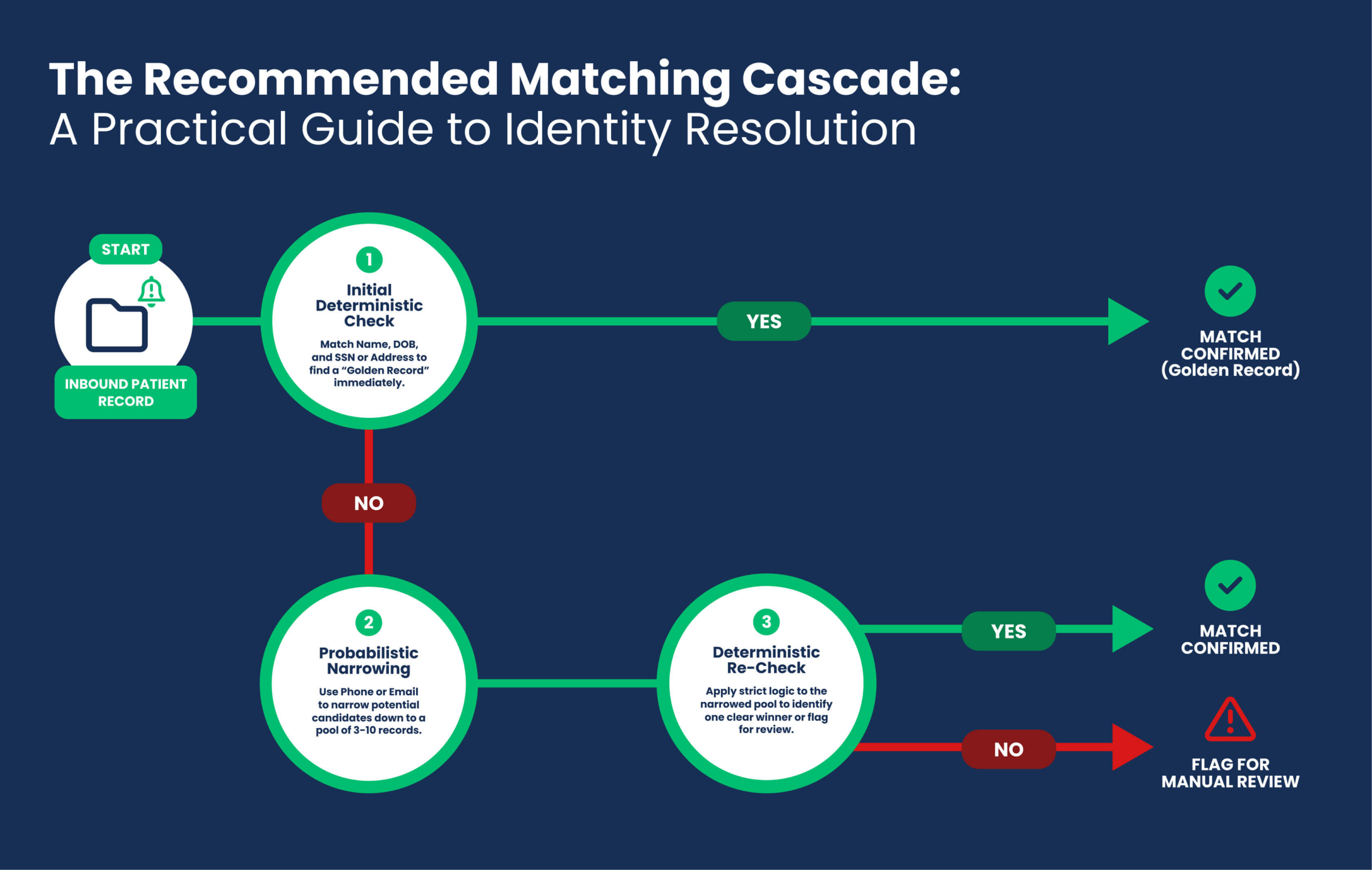
Start with deterministic matching using date of birth along with SSN or address with longitudinal history. If that fails, use probabilistic methods like phone and email to narrow your candidate pool to 3-10 records. Then re-apply deterministic strategies to that smaller set. This cascade approach maximizes accuracy while minimizing manual review burden.
If that approach fails, then move to advanced matching strategies to attempt to detect common errors that prevent patient matching. These techniques can improve match rates further.
The gap between data collection and usage remains the industry’s biggest opportunity. If your organization collects SSNs from 84% of patients but only uses them for 42% of matching operations, you’re leaving deterministic accuracy on the table. Fix your implementation before seeking new data sources.
Digital Wallets Bridge the Gap
Digital wallets like ID.me that meet the federal and healthcare certifications for patient direct right of access can significantly improve patient experience and patient matching. By providing a “golden record” in a patient consent driven data sharing model, a complete set of the reference data healthcare organizations need to match is provided at the front door. Because identities are reusable – ID.me alone has already issued more than 80 million credentials that meet the federal standards set by NIST – security and convenience go hand in hand.
Achieving a ‘Golden Record’ through accurate matching is a critical milestone, but it isn’t the finish line. Once you have matched the patient, how do you secure that data for the long haul? In Part 3, we explore Digital Identifiers, moving beyond repeated PII exchange to a secure, tokenized future.