


Recently, Murat Mayor, a 58-year-old living in the Bay Area, began applying for financial aid for his teenage son who was preparing to go to college. According to ABC news, Mayor quickly discovered that scammers had stolen his son’s identity — and his own — and were using their identities to fraudulently apply to community colleges across the U.S.
Many of the over 5 million real students who are enrolled in community colleges across the U.S. can apply for Pell Grants that don’t need to be paid back using a program called Free Application for Federal Student Aid, or FAFSA. But fraudsters are applying, too. And when those fraudsters succeed, real students, whose stolen Social Security numbers can be bought for less than $6 on the dark web, are in for a rude awakening. They’re told their funds have already been approved and disbursed. Their college dream has been stolen. The hours they might have spent in the classroom will be spent trying to reclaim their identity.
“Ghost Students”
This is FAFSA fraud. And it’s far more common than most people realize.
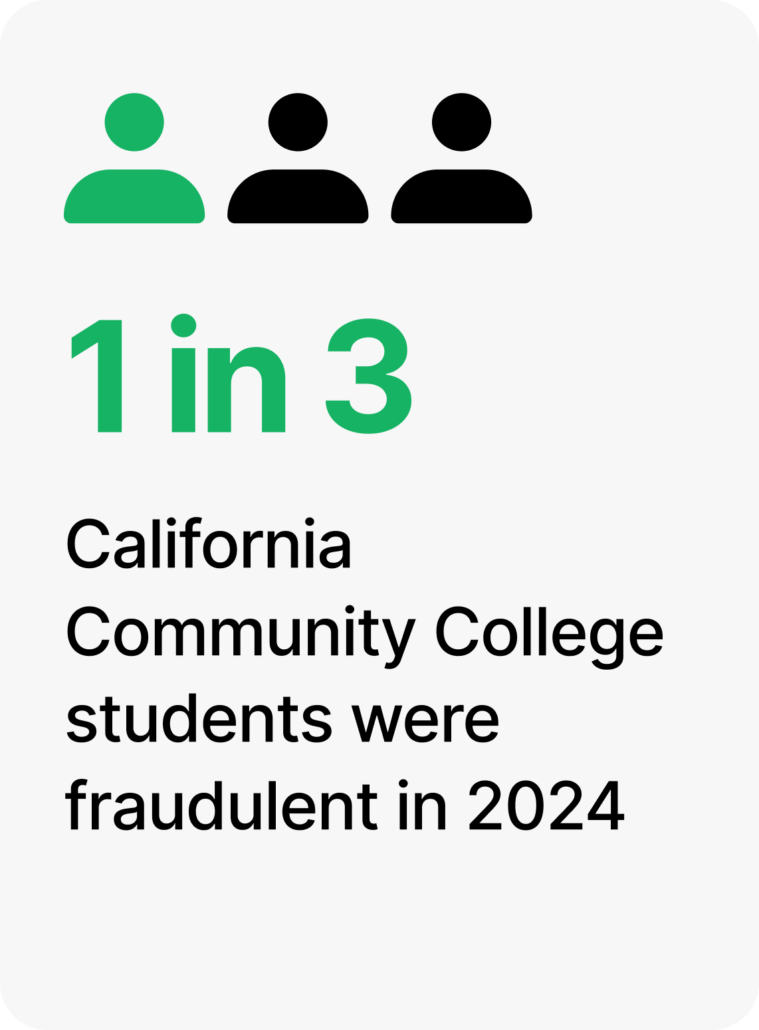
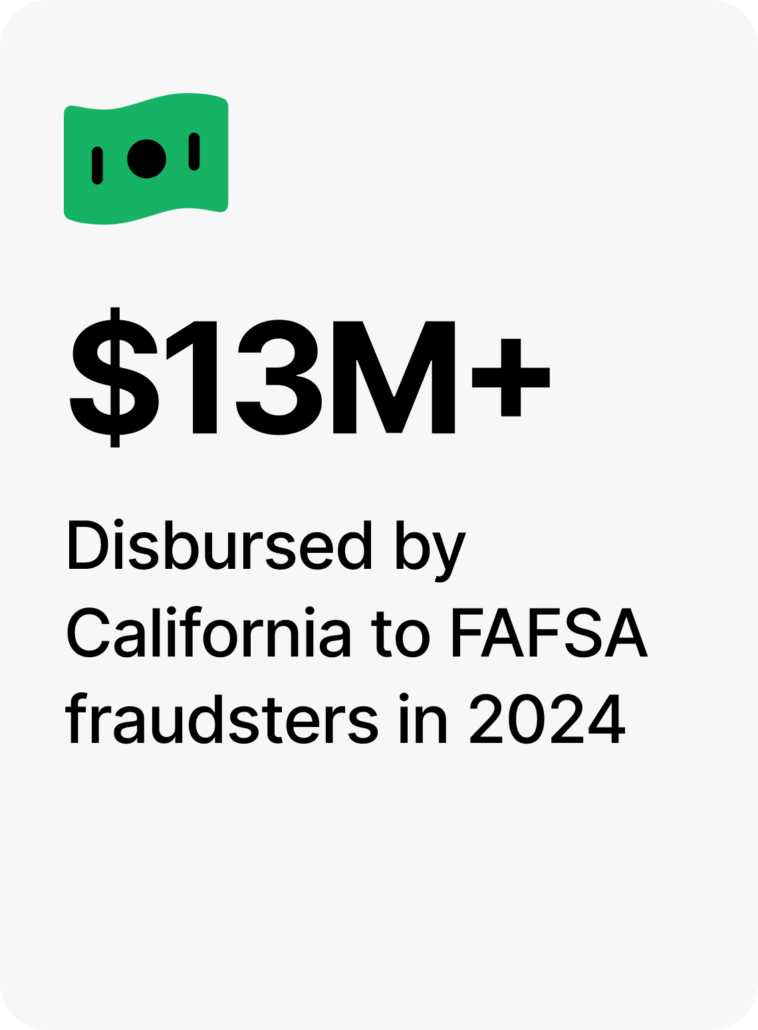
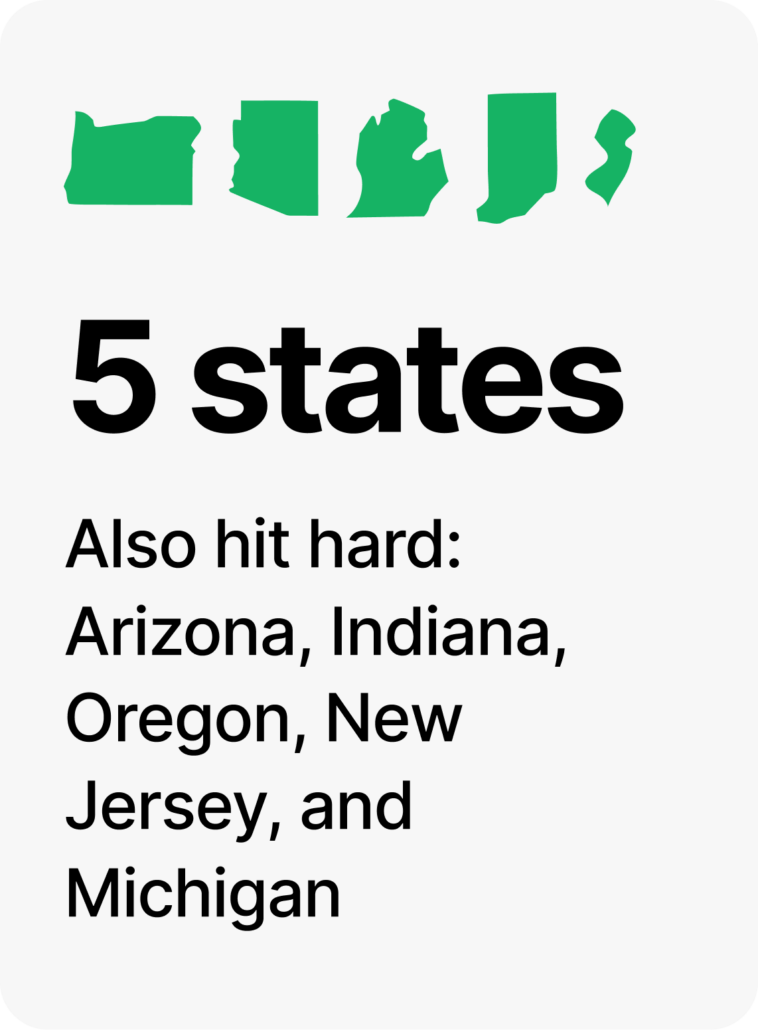
In a single recent FAFSA cycle, the Department of Education identified nearly 150,000 suspect identities in active applications. In certain states, fraud has reached nearly unbelievable levels: In 2024, nearly one in three California Community College students were fraudulent. That year, California disbursed upwards of $13 million to FAFSA fraudsters. Schools in Arizona, Indiana, Oregon, New Jersey, and Michigan have also been hit hard. Nationally, nearly $90 million in FAFSA funds were incorrectly paid out to ineligible individuals in 2025.
Community colleges are prime targets. They offer open enrollment, have historically weak identity verification standards, and can often be attended entirely online.
Fraudsters go after Pell Grants specifically — they pay out a maximum of just over $7,000 and don’t have to be repaid. Grants meant for underprivileged students become targets for someone with a stolen Social Security number (available on the dark web on the cheap) or an AI-generated “synthetic persona” that blends real and fabricated details.
“The problem happens when colleges use less rigorous standards for their application process,” says Jeffrey Jackson, Fraud Investigations Lead at ID.me, who has 33 years of law enforcement experience, including decades spent fighting fraud with the FBI. Community colleges often require high school transcripts as part of acceptance — and fraudsters submit real or AI-generated versions to establish a false identity. Once accepted, they file for FAFSA using those stolen or fabricated credentials, claiming homelessness or the lowest income bracket to maximize their Pell Grant payout.
Then these ghost students “show up” for class — often via AI tools to game online course formats. After a few weeks of simulated attendance, they become eligible for Pell grant disbursement. After receiving their check, they disappear.
The repercussions for real students are severe. Victims — often young people, sometimes minors — don’t just lose access to Pell Grants they were entitled to. They may be saddled with repaying stolen funds or investigated as fraud suspects themselves. Colleges suffer too. Ghost students fill seats and block legitimate enrollment. Educators at some community colleges describe “full” classes with hundreds of students waitlisted — while seats occupied by fraudsters sit empty and taxpayer dollars disappear.

A New Focus on Stopping FAFSA Fraud
Since 2024, universities and the federal government have moved to strengthen identity verification. In 2026 the House of Representatives passed the “No Aid for Ghost Students Act,” which would require the Department of Education to apply a level of identity fraud detection to every FAFSA application. (The act has been introduced in the Senate and referred to committee.) The Department of Education estimates that stronger identity verification could save taxpayers over $1 billion in a single FAFSA cycle.
It’s a good start. “By requiring NIST IAL2-compliant verification, this bill closes a critical vulnerability in our student aid system,” Jackson says. “Knowledge-based verification — relying on questions about a person’s history — has long been exploited by fraudsters who can readily obtain that information through data breaches and social engineering. Elevating the standard to NIST IAL2 means we’re anchoring identity to something real and verifiable, like document-backed biometric verification, not just something knowable. But legislation sets a floor, not a ceiling — sophisticated fraudsters adapt quickly, and institutions that want to stay ahead of them need a continuously evolving identity verification partner, not just a compliance checkbox.”
AI has made the FAFSA fraud threat harder to contain. Using AI tools, fraudsters can attack at scale, controlling thousands of applications. They’re manufacturing thousands of synthetic IDs to put through the system at once. “Fraud prevention is never static — it’s a cat and mouse game,” Jackson says. “Every time an organization closes one vulnerability, fraudsters begin searching for another way in.”
How ID.me Stops FAFSA Fraud
The results of stronger identity verification are already clear. At one community college that implemented ID.me’s identity proofing solution — compliant with NIST Identity Assurance Level 2 (IAL2) standards — ID.me prevented an estimated $425,535 in fraudulent aid disbursements in the first four weeks of the Spring 2026 semester alone.
Before the change, the college relied on manual, paper-based processes. The shift to ID.me reduced paper-based processing by more than 90% and brought average verification time down to approximately four minutes per student.

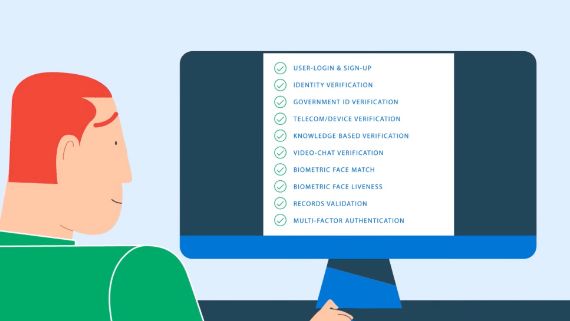
ID.me’s identity proofing process guides students through a self-service flow. Most complete it independently in minutes — securely uploading documentation and completing automated checks. Students who cannot complete self-service are routed to a live video chat with a trained ID.me Trusted Referee. ID.me offers multiple verification pathways, guided by its commitment to “No Identity Left Behind.” In all, the new system verified over 11,000 students for the spring semester.
Stronger identity verification — including live video verification — helps stop FAFSA fraud before it reaches the classroom. But the cat-and-mouse game continues. As threat actors develop new methods to bypass security requirements and target community colleges, ID.me continues to evolve its defenses. Ghosts beware.